Oral Appliance Therapy vs. CPAP: Which Sleep Apnea Treatment Is Right for You?
A clear, honest comparison for Cleveland-area patients weighing a CPAP machine against a custom oral appliance like Optisleep.
Quick Answer
| Best for mild to moderate sleep apnea | Oral appliance therapy (e.g., Optisleep) |
| Best for severe sleep apnea | CPAP, or CPAP combined with an oral appliance |
| Typical oral appliance cost | $1,800–$3,500, often billed to medical insurance |
| Nightly compliance | Oral appliances are worn more consistently by most patients |
| How treatment is decided | A sleep study confirms severity; your dentist and sleep physician coordinate care |
In This Article
- What Sleep Apnea Actually Does to Your Body
- How CPAP Therapy Works
- How Oral Appliance Therapy Works
- CPAP vs. Oral Appliance: Side-by-Side Comparison
- Why We Use Optisleep
- Who Is a Candidate for Each Treatment
- How to Decide Which Is Right for You
- Insurance & Financing
- Questions to Ask Before You Decide
- Frequently Asked Questions
What Sleep Apnea Actually Does to Your Body
Obstructive sleep apnea happens when the soft tissue at the back of your throat collapses during sleep, repeatedly blocking your airway. Every time that happens, your brain briefly wakes you just enough to reopen the airway — sometimes dozens or hundreds of times a night, almost always without you remembering it in the morning.
Patients rarely come to us saying "I think I have sleep apnea." They come to us saying they're exhausted no matter how much they sleep, their spouse says they gasp or stop breathing at night, they wake up with headaches or a dry mouth, or their doctor flagged high blood pressure that won't budge. Left untreated, sleep apnea is linked to a meaningfully higher risk of hypertension, heart disease, stroke, type 2 diabetes, and daytime drowsiness serious enough to affect driving safety.
The good news is that once sleep apnea is diagnosed through a sleep study, there are two well-established, evidence-backed paths to treating it: CPAP therapy and oral appliance therapy. Neither is universally "better" — the right choice depends on the severity of your apnea, your anatomy, and, frankly, which treatment you'll actually use every night.
How CPAP Therapy Works
CPAP stands for continuous positive airway pressure. A bedside machine pushes a steady stream of pressurized air through a hose into a mask worn over your nose or nose and mouth, physically keeping your airway open all night. CPAP has been the long-standing gold-standard treatment for sleep apnea, and for good reason — when it's used consistently and correctly, it is highly effective at eliminating apnea events, even for severe cases.
The catch is the word "consistently." CPAP only works while it's being worn, and a large share of patients struggle with it long-term: the mask can feel claustrophobic, the machine and hose limit sleeping positions and make travel more complicated, some people develop nasal congestion or dry mouth, and partners sometimes struggle to sleep next to the noise. Sleep medicine research has repeatedly found that a substantial percentage of patients prescribed CPAP stop using it regularly within the first year.
How Oral Appliance Therapy Works
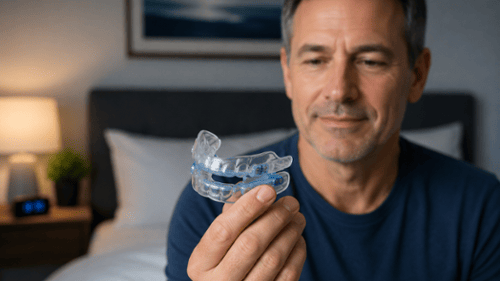
An oral appliance is a custom-fitted device, similar in size to a mouthguard or retainer, that you wear only while you sleep. Rather than forcing air into your airway, it gently repositions your lower jaw and tongue forward, which keeps the airway from collapsing in the first place. There is no machine, no hose, and no mask — just a small, precisely fitted device that fits in your pocket or nightstand drawer.
Oral appliance therapy is prescribed after your sleep physician confirms, through a sleep study, that you're a candidate — and it's typically recommended first-line for mild to moderate obstructive sleep apnea, or as an alternative for patients with more severe apnea who cannot tolerate CPAP. As a dentist, this is where our role fits into your care: we don't diagnose sleep apnea, but we design, fit, and adjust the oral appliance in close coordination with your physician once a diagnosis is in place.
Why We Use Optisleep
Not all oral appliances are built the same way, and the appliance you're fitted with matters as much as the decision to try oral appliance therapy in the first place. We use Optisleep appliances because they're designed for precise, incremental jaw positioning, durable daily wear, and a comfortable fit that patients are far more likely to actually use every night. A well-fitted appliance that sits in a drawer unused helps no one — the appliance and the adjustment process both matter.
During your evaluation, we'll walk you through whether Optisleep or another appliance design is the better fit for your bite, your jaw anatomy, and the severity of your apnea.
CPAP vs. Oral Appliance Therapy: Side-by-Side Comparison
| Factor | CPAP | Oral Appliance (e.g., Optisleep) |
|---|---|---|
| Effectiveness for mild–moderate OSA | Highly effective | Highly effective, often equally so |
| Effectiveness for severe OSA | Gold standard | Can help, sometimes combined with CPAP |
| Comfort | Mask and hose can feel restrictive | Small, mouthguard-like, no machine |
| Real-world nightly compliance | Often inconsistent long-term | Generally higher and more consistent |
| Travel & portability | Requires packing a machine and power source | Fits in a pocket or small case |
| Noise | Machine hum may disturb a partner | Silent |
| Maintenance | Regular cleaning, filter and hose replacement | Daily rinse, periodic dental check-ins |
| Common side effects | Nasal congestion, dry mouth, skin irritation | Mild jaw or bite soreness, especially early on |
| Typical cost | Machine plus ongoing supplies | $1,800–$3,500, often medically billed |
Individual results vary based on the severity of your sleep apnea, your anatomy, and how consistently a treatment is used. This comparison reflects general clinical patterns and is not a substitute for a personalized evaluation.
Who Is a Candidate for Each Treatment
Oral appliance therapy tends to be a strong fit if:
- Your sleep study shows mild to moderate obstructive sleep apnea
- You've tried CPAP and found it difficult to tolerate or stick with
- You travel frequently or want a discreet, low-maintenance option
- You have enough healthy teeth and jaw structure to support a custom appliance
- You don't have significant jaw joint (TMJ) issues that a physician or dentist has flagged as a concern
CPAP may be the more appropriate starting point if:
- Your sleep study shows severe obstructive sleep apnea
- Your physician recommends CPAP as first-line therapy based on your specific diagnosis
- You have limited natural teeth or significant periodontal issues affecting appliance retention
Many patients also do well on a combination approach — using CPAP at a lower, more tolerable pressure alongside an oral appliance. This decision is always made together with your treating sleep physician.
How to Decide Which Is Right for You
If you haven't been diagnosed yet, the first step is always a sleep study — either an in-lab study or a validated home sleep test ordered by a physician. That study tells us how severe your apnea is, which is the single biggest factor in choosing a treatment path.
If you've already been diagnosed and are currently using CPAP but struggling with it, that's one of the most common reasons patients come to see us. We'll review your diagnosis, evaluate your teeth, jaw, and bite, and coordinate directly with your sleep physician to determine whether an oral appliance is a safe and effective option for your specific case — either as a replacement for CPAP or alongside it.
If you haven't been diagnosed at all but recognize the symptoms — loud snoring, witnessed pauses in breathing, morning headaches, or persistent daytime fatigue — the right first step is a conversation with us or your physician about getting a sleep study scheduled.
Insurance & Financing
Oral appliance therapy for diagnosed obstructive sleep apnea is typically billed to medical insurance, not dental insurance, since it's treating a diagnosed medical condition. Our team handles the coordination of medical billing, prior authorization, and documentation from your sleep study on your behalf. We also accept CareCredit financing, and the treatment is HSA/FSA eligible for patients who prefer to use those funds.
Estimated insurance benefits are not guarantees of payment. Actual coverage is determined by your individual insurance provider and plan.
Questions to Ask Before You Decide
- What does my sleep study say about the severity of my apnea?
- Am I a good anatomical candidate for an oral appliance?
- Will my medical insurance cover an oral appliance, and what will I owe?
- How will my dentist and sleep physician coordinate my care and monitor progress?
- What does the adjustment period feel like, and how long does it typically take?
- Is a combination of CPAP and an oral appliance a better fit for my case?
What Patients Say
Not Sure Which Treatment Fits Your Life?
Schedule a sleep consultation at Hudzinski Dental and let's find the treatment you'll actually stick with.
Call (440) 585-4200 Schedule OnlineFrequently Asked Questions
Is an oral appliance as effective as CPAP?
For mild to moderate obstructive sleep apnea, research shows oral appliance therapy can be similarly effective to CPAP, especially once real-world compliance is factored in. For severe apnea, CPAP is generally considered more reliably effective, though some patients still benefit significantly from an oral appliance or a combination approach.
Do I need a sleep study before getting an oral appliance?
Yes. A sleep study, ordered by a physician, is required to diagnose sleep apnea and determine its severity before any oral appliance can be fitted. We work closely with sleep physicians in the area to coordinate this step if you haven't already had one.
Will my medical insurance cover an Optisleep appliance?
Many medical insurance plans provide coverage for oral appliance therapy once obstructive sleep apnea has been medically diagnosed. Our team verifies your specific benefits and handles the billing coordination. Estimated benefits are not a guarantee of payment, and actual coverage depends on your plan.
Can I switch from CPAP to an oral appliance?
Many patients do, particularly if they've struggled to use CPAP consistently. That decision should be made together with your sleep physician and your dentist, based on your diagnosis and how well CPAP has or hasn't worked for you.
Does an oral appliance have side effects?
Some patients notice mild jaw soreness, tooth or bite sensitivity, or increased salivation during the first few weeks as their mouth adjusts. These effects are usually temporary and can often be minimized with adjustments made during follow-up visits.
How long does an oral appliance last?
With proper care, most oral appliances last several years before needing replacement, though this varies based on nightly wear, grinding habits, and changes in your bite over time. Regular dental check-ins help us catch wear issues early.
About the Author: Dr. Matthew Hudzinski, DMD, is the owner and treating dentist at Hudzinski Dental in Mayfield Heights, Ohio, serving patients throughout the Cleveland area including Beachwood, Pepper Pike, Lyndhurst, Highland Heights, Solon, and Gates Mills.
Information provided on this website is intended for educational purposes only and should not replace professional dental or medical advice, diagnosis, or treatment. A comprehensive examination and consultation, including a physician-ordered sleep study where applicable, are required before treatment recommendations can be finalized.