Dental Implants
A missing tooth is easy to ignore at first. Maybe it's a back molar nobody sees, or a tooth that cracked and had to come out last year. Then you notice you're chewing on the other side. Food catches in the gap. The teeth next to it start to tilt. Sooner or later, you're asking a question we hear often: should I get a bridge or an implant?
Both are proven, fixed options that look and feel like real teeth. They work in very different ways, though, and the right one depends on your mouth, your timeline and your budget. Below we walk through how each works, where each one wins, and the questions that usually decide it. If you already know you'd like to explore implants, our dental implants page covers the full process.
Why a Single Gap Matters
One missing tooth affects more than the space it leaves. Your teeth work as a team. When one is gone, a few things tend to happen over months and years:
- Neighbors drift. Teeth on either side slowly lean into the gap, which can change your bite and create spots that are hard to clean.
- The opposing tooth moves. The tooth above or below the gap can drift up or down into the empty space.
- The bone shrinks. Without a root to stimulate it, the jawbone in that area gradually resorbs.
- Chewing shifts. Favoring one side puts extra wear on the teeth that are left.
A bridge and an implant both close the gap and stop teeth from drifting. Only an implant replaces the root.
How a Dental Bridge Works
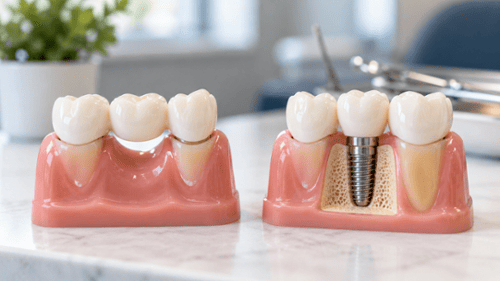
A traditional bridge is a single piece with three parts: a replacement tooth in the middle (the pontic) and a crown on each end. To place it, we reshape the healthy teeth on either side of the gap so the crowns fit over them. The whole bridge is then cemented in place.
Bridges have a long track record and a few real strengths. Treatment is quick, with no surgery and no healing period. A bridge can be a good choice when the teeth next to the gap already have large fillings or crowns, since covering them can protect them too. With our CEREC technology, some bridges can be designed and made right in our office.
The tradeoffs: reshaping healthy teeth can't be undone, the anchor teeth carry extra load, and you'll need a floss threader or water flosser to clean under the pontic. Bridges commonly last about 10 to 15 years, sometimes longer with excellent care.
One more thing to know: a bridge is only as strong as the teeth holding it up. If decay starts under one of the anchor crowns, or one of those teeth cracks, the whole bridge usually has to come off. That's why regular checkups and X-rays matter so much once you have one. We look closely at the edges of every bridge at your cleaning visits so small problems get caught before they put the anchor teeth at risk.
How a Dental Implant Works
An implant replaces the tooth from the root up. A small titanium post is placed in the jawbone, where it fuses with the bone over a few months. Then we attach a custom crown on top. The teeth next to the gap aren't touched.
Because it acts like a root, an implant helps keep the bone in that area from shrinking. You brush and floss it like a natural tooth. With good care, implants have a long-term success rate of roughly 95 to 98 percent over 10 years, and the post itself is meant to be permanent.
The tradeoffs: it takes longer, usually four to eight months from start to final crown, and it involves a minor surgery. You need enough healthy bone, or a graft to rebuild it first.
Bridge vs. Implant at a Glance
| Dental bridge | Dental implant | |
|---|---|---|
| Neighboring teeth | Reshaped to hold the bridge | Left untouched |
| Jawbone | Continues to shrink under the gap | Helps preserve bone |
| Time to finish | Usually a few weeks or less | Usually 4–8 months |
| Surgery | None | Minor surgery, local anesthesia |
| Cleaning | Floss threader or water flosser under the bridge | Brush and floss like a natural tooth |
| Typical lifespan | About 10–15 years | Often decades; the crown may need replacing |
| Upfront cost | Often lower | Often higher |
| Long-term cost | May need replacing once or twice | Often lower over 20+ years |
Five Questions That Usually Decide It
When we talk through this choice with patients, the answer usually comes down to a handful of questions. Here's the order we work through them:
- What shape are the neighboring teeth in? If they're healthy and unfilled, an implant spares them. If they already need crowns, a bridge can replace the missing tooth and crown both neighbors at once.
- How much bone is there? A 3-D CBCT scan shows whether there's enough bone for an implant now, or whether a graft would come first.
- How is your overall health? Gum disease, uncontrolled diabetes or heavy smoking can affect implant healing. Those don't always rule an implant out, but they shape the plan.
- What's your timeline? A wedding in six weeks favors a bridge or a temporary option. If you can wait a few months, an implant is usually the longer-lasting answer.
- How long do you want this to last? If you're thinking 20 or 30 years ahead, the math often favors an implant, even though it costs more on day one.
Is an Implant Right for You?
An implant is often the better fit if:
- The teeth next to the gap are healthy and you'd rather not reshape them
- You want the most natural feel and the easiest daily cleaning
- You care about keeping your jawbone and facial shape over the long run
- You can allow a few months for healing
A bridge may make more sense if:
- The neighboring teeth already have large fillings or need crowns
- There isn't enough bone, and you'd prefer not to have a graft
- You need the gap filled quickly
- A health condition makes surgery a poor choice right now
There's no wrong answer, only the one that fits you. A short exam and a 3-D scan usually make the choice clear.
"I generally prefer an implant when the neighboring teeth are healthy because it allows us to replace the missing tooth without altering them. However, if those teeth already have large restorations or need crowns, a bridge can be an excellent option. My recommendation always comes down to what makes the most sense for the patient's long-term dental health." - Dr. Matthew Hudzinski, DMD
What About Cost and Insurance?
A bridge often costs less upfront. An implant often costs less over time, because a bridge may need to be replaced once or twice over the decades an implant can last. Our guide to dental implant cost in Cleveland breaks down typical ranges.
Many dental plans cover part of either option, though coverage for implants varies more from plan to plan. We accept all PPO insurance plans, in network or out of network, and we'll check your benefits before you decide. We also offer flexible monthly payment options and an in-house savings plan for patients without insurance. And if you have dental benefits left this year, read our year-end benefits checklist before they reset.
Replacing a Missing Tooth in Mayfield Heights
Hudzinski Dental has cared for patients on Cleveland's east side since 1992. Dr. Kevin Fryer founded the practice and mentored Dr. Matthew Hudzinski, who leads it today. Both doctors see patients.
We plan with a CBCT 3-D scan and a digital iTero scan instead of goopy impressions, and we 3-D print implant surgical guides in our office. If you're nervous about treatment, ask about sedation.
Our office is at 1232 SOM Center Road in Mayfield Heights, an easy drive from Lyndhurst, Highland Heights, Beachwood, Pepper Pike and Gates Mills.
Frequently Asked Questions
Is a bridge or an implant better for one missing tooth?
For many people with healthy neighboring teeth and enough bone, an implant is the longer-lasting choice because it doesn't involve other teeth and helps preserve bone. A bridge can be better when the neighboring teeth already need crowns or when an implant isn't practical. An exam tells us which fits you.
How long does a dental bridge last?
Most bridges last about 10 to 15 years, and some last longer. Good cleaning under the bridge and regular checkups make the biggest difference.
Can I switch from a bridge to an implant later?
Often, yes. When a bridge eventually needs replacing, we can evaluate whether implants are possible. Bone may have shrunk under the bridge, so a graft is sometimes needed first.
Does getting an implant hurt more than a bridge?
Both are done with local anesthesia. An implant involves a minor surgery, so expect a few days of mild to moderate soreness. Most patients manage it with over-the-counter pain relievers. Sedation is available if you're anxious.
Is there an option between a bridge and an implant?
Yes. Depending on your teeth, a resin-bonded (Maryland) bridge or a removable partial may be an option. Each has limits, and we'll explain at your visit which ones fit your situation.
Will insurance pay for a bridge or an implant?
Many plans cover part of a bridge, and more plans now cover part of an implant, but it varies widely. We'll check your specific benefits and give you a written estimate before treatment.
Talk Through Your Options
You don't have to decide alone. At a consultation, we'll look at the gap on a 3-D scan, explain what a bridge and an implant would each involve for you, and give you a clear estimate. Call (440) 585-4200 or request an appointment online.
Request an Appointment Call (440) 585-4200Reviewed by Dr. Matthew Hudzinski, DMD
This article is for general information and is not a substitute for an in-person exam.
Hudzinski Dental, 1232 SOM Center Road, Mayfield Heights, OH 44124 | (440) 585-4200 | Mon–Thu 8:00 AM–5:00 PM, Fri 8:00 AM–1:00 PM.