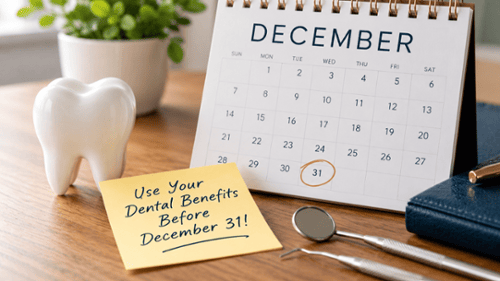
Use It or Lose It: How to Use Your Dental Benefits Before December 31
October 13, 2026 | 7 minute read | Reviewed by Dr. Matthew Hudzinski, DMD
Every January, a lot of people lose money they never knew they had. If your dental plan runs on the calendar year, any benefits you don't use by December 31 usually disappear. Your deductible starts over too. And if you set aside money in a flexible spending account, part of it may be gone as well.
The good news is that a little planning in October and November can turn those leftover dollars into a cleaning, a filling you've been putting off, or the crown your dentist mentioned in the spring. With same-day CEREC crowns, even a crown can be finished in a single visit before the year ends. Here's how to make the most of what you've already paid for.
Why December Matters for Dental Insurance
Most dental plans pay up to an annual maximum, often somewhere around $1,000 to $2,000 per person per year. Whatever you don't use doesn't roll over in most plans. It simply resets.
You've also paid premiums all year to have that coverage. Skipping care doesn't get that money back. It just means the benefits went unused.
There's a timing issue too. November and December are the busiest months in many dental offices, ours included, because so many people remember their benefits at the same time. Appointments fill quickly, and the office closes for a few days around the holidays. If you wait until mid-December, you may not find a time that works.
What Resets, and What Doesn't
Not every account works the same way. This quick table shows what usually happens on January 1.
| Benefit | What usually happens at year-end | What to do now |
|---|---|---|
| Annual maximum | Resets to zero used; unused dollars are lost in most plans | Schedule needed care before the plan year ends |
| Deductible | Starts over | If you've already met it, more care this year costs you less |
| Preventive visits | Twice-yearly cleanings and exams are covered per plan year in many plans | Book any cleaning you haven't used |
| FSA (flexible spending account) | Often "use it or lose it," though some employers allow a short grace period or a small carryover | Check your balance and your employer's deadline |
| HSA (health savings account) | Rolls over; the money stays yours | No rush, but it's a good way to pay for care |
| In-house savings plan | Follows your membership dates, not the calendar | Ask us when your membership renews |
One caution: some plans run on a fiscal year instead of the calendar year. Your benefits summary or your HR department can tell you the exact date your plan renews. Our team can also look it up for you.
Your Year-End Dental Benefits Checklist
Here's the simple process we suggest to patients every fall:
1. Find out what's left
Log in to your insurance portal or call the number on your card. Ask for your remaining annual maximum, whether you've met your deductible, and your plan's renewal date. Or call us, and we'll check for you.
2. Book your cleaning and exam
If you haven't had both of this year's preventive visits, schedule them now. Regular cleanings catch small problems while they're still small.
3. Look back at past recommendations
Did we mention a cracked filling, a tooth that needs a crown, or a gum concern at your last visit? Your remaining benefits may cover a good share of it this year.
4. Ask for a pre-treatment estimate
For bigger work, we can send a pre-determination to your insurance so you know your share before treatment.
5. Schedule early
Aim for October or early November. If treatment takes more than one visit, starting early leaves room to finish before the plan resets.
6. Use your FSA
Pay your share with your FSA card so pre-tax dollars don't go to waste.
"Every January, I have patients who wish they'd taken care of a tooth before the holidays. What might have been a straightforward filling or crown can sometimes become a much bigger, more expensive problem. I always encourage patients to be proactive, especially when they have insurance benefits they've already paid for." - Dr. Matthew Hudzinski, DMD
What Your Dental Benefits Usually Cover
Every plan is different, but many PPO plans sort care into three groups. Knowing which group your treatment falls into helps you estimate what's left to pay.
- Preventive care: cleanings, exams and routine X-rays. Many plans cover these at or near 100 percent, often without touching your deductible.
- Basic care: fillings, simple extractions and often root canals and gum treatment. Plans commonly pay a large share after the deductible.
- Major care: crowns, bridges, dentures and sometimes implants. Plans typically pay a smaller share, and this is where the annual maximum runs out fastest.
That's why a crown is often the best use of leftover benefits. It's the kind of care that gets more expensive the longer you wait. A tooth that needs a crown today can crack or need a root canal later, and that costs more in time, comfort and money.
Your exact percentages, waiting periods and frequency limits are in your plan's benefits summary. We're happy to read it with you and translate it into plain numbers before you book.
Have benefits left this year?
We will check what you have remaining and help you use it before it resets.
Request an Appointment Call (440) 585-4200Don't Forget Your FSA or HSA
A flexible spending account lets you pay for eligible health expenses with pre-tax money. Dental care generally counts, including cleanings, fillings, crowns, root canals, implants, night guards and orthodontic treatment like Invisalign. Purely cosmetic services, such as teeth whitening, usually don't qualify.
Most FSAs are "use it or lose it." Some employers give a grace period of up to a couple of months into the new year, or let you carry over a limited amount, but not both. Check your plan rules before you count on either.
A health savings account is different. HSA money rolls over year after year, so there's no deadline. It's still a smart, tax-advantaged way to pay for treatment whenever you need it.
Smart Ways to Split Bigger Treatment
If you need more care than one year's maximum will cover, timing can help. For example, a treatment plan with several crowns might be split so part is done in December and the rest in January. That way, you use this year's remaining benefits and next year's fresh ones.
This works well for treatment that can safely be staged. It isn't the right approach for an infection, a painful tooth or a problem that will get worse with waiting. We'll tell you honestly which is which. Implant treatment, which naturally spans a few months, can often be planned across two benefit years as well.
If your share is more than you'd like to pay at once, we offer monthly payments through CareCredit, Sunbit, Health Finance Direct, Proceed Finance and Alphaeon. No insurance? Our in-house savings plan includes preventive care and discounts on treatment, with no deductibles or annual maximums.
Is a Year-End Visit Right for You?
A visit before December 31 makes sense if:
- You have dental insurance and haven't had a cleaning in the last six months
- We've recommended a filling, crown or other treatment you haven't scheduled
- You have FSA money left for this year
- You've met your deductible and have room left in your annual maximum
- A tooth has been bothering you, even a little
If none of these apply, you're in great shape. Just keep your regular six-month schedule.
Using Your Benefits in Mayfield Heights
Hudzinski Dental has served families on Cleveland's east side since 1992. We accept PPO plans and are in network with Aetna, Delta Dental, Guardian, MetLife and Principal. Our team files your claims and explains your benefits in plain language, so you know what to expect before you sit down.
Same-day CEREC crowns are especially helpful at year-end. Instead of a temporary crown and a second visit weeks later, we design, mill and place your crown in one appointment. That makes it easier to finish before your benefits reset.
We're at 1232 SOM Center Road in Mayfield Heights, close to Lyndhurst, Highland Heights, Mayfield Village, Beachwood and Pepper Pike. We're open Monday through Thursday from 8:00 AM to 5:00 PM and Friday from 8:00 AM to 1:00 PM.
Frequently Asked Questions
Do dental benefits really expire at the end of the year?
For most calendar-year plans, yes. Unused annual maximums reset on January 1 and don't carry over. A few plans include a rollover feature, and some renew on a different date, so check your plan or ask us.
Can you check my remaining benefits for me?
Yes. Call us with your insurance information, and our team will look up your remaining maximum, deductible and renewal date.
Can I use my FSA at the dentist?
Yes. Most dental treatment is an eligible FSA expense, including cleanings, fillings, crowns and orthodontics. Cosmetic-only services like whitening usually aren't.
What if I need more work than my insurance will cover this year?
We can often stage treatment across December and January to use two years of benefits, as long as waiting is safe. Financing is also available for the rest.
Is it worth getting a crown in December?
If you've been told you need one and you have benefits left, it often is. With same-day CEREC crowns, the whole crown is usually done in one visit.
I don't have dental insurance. What are my options?
Ask about our in-house savings plan. It covers preventive care and gives you discounts on treatment, with no deductibles, waiting periods or annual maximums.
A Natural Next Step
Book Before the Calendar Fills
Your benefits are already paid for. Let's make sure you use them. If a crown is on your list, ask about a same-day CEREC crown so you're done in one visit.
Schedule an Appointment Same-Day CEREC CrownsRelated Reading
- Same-Day CEREC Crowns Explained
- Dental Crown vs. Filling: How to Know Which One Your Tooth Needs
- How Much Do Dental Implants Cost in Cleveland?
This article is for general education and is not a substitute for an in-person exam. Treatment recommendations depend on your individual needs. Hudzinski Dental, 1232 SOM Center Road, Mayfield Heights, OH 44124 | (440) 585-4200