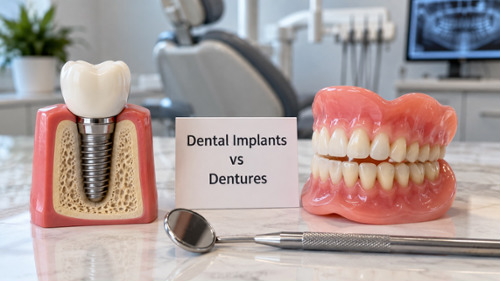
Dental Implants vs. Dentures: A Full Comparison
Updated October 3, 2026 | 6 minute read | Reviewed by Dr. Matthew Hudzinski, DMD
Missing teeth leave you with a real decision. Implants and dentures both restore your smile, but they work very differently, and that difference shows up every time you eat, talk, and laugh.
This guide compares the two side by side: stability, bone health, comfort, and what each really costs over time.
At Hudzinski Dental in Mayfield Heights, Dr. Matthew Hudzinski plans tooth replacement for patients across Cleveland's east side using CBCT 3D imaging and guided implant surgery. Here is what we tell patients weighing both options.
What Is the Difference?
A dental implant is a small titanium post placed in the jawbone, where it acts as a new tooth root. Once the bone fuses to it, a process called osseointegration, a crown, bridge, or denture is attached on top.
A denture is a removable set of replacement teeth. Full dentures rest on the gums. Partial dentures clip onto remaining teeth. Implant-supported dentures lock onto a few implants, combining both approaches.
The key distinction: implants are anchored in bone. Traditional dentures sit on top of it.
Implants vs. Dentures at a Glance
Here is how the two compare on the factors patients ask about most.
| Traditional Dentures | Dental Implants | |
|---|---|---|
| Stability | Can shift or slip | Fixed in the jawbone |
| Bone health | Bone continues to shrink | Helps preserve bone |
| Chewing | Reduced bite force | Close to natural teeth |
| Daily care | Removed nightly to clean | Brush and floss normally |
| Lifespan | Reline or replace every 5 to 8 years | 25 years or longer with care |
| Upfront cost | Lower | Higher |
| Long-term cost | Adds up with replacements | Often comparable or lower |
Why Bone Health Changes Everything
Your jawbone stays strong because tooth roots stimulate it every time you chew. When a tooth is lost, that stimulation stops and the bone begins to shrink.
Traditional dentures do not replace the root, so the shrinking continues underneath them. Over time the denture loosens, needs relining, and the lower face can start to look sunken.
Implants replace the root itself. They are the only tooth replacement that helps preserve the bone around them.
Good to know: Bone loss begins within months of losing a tooth. The sooner you are evaluated, the more options you typically have. In some cases, a bone graft placed at the time of extraction protects the site for a future implant.
Everyday Life: Eating, Speaking, and Confidence
- Eating. Implants restore bite force close to natural teeth. Steak, apples, and corn on the cob are back on the menu.
- Speaking. Implants do not affect speech once healed. Dentures can click or shift, and a full upper denture covers the palate.
- Daily care. Implants are brushed and flossed like natural teeth. Dentures come out nightly for cleaning and soaking.
- Confidence. No adhesive and no slipping mid-conversation. For many patients, this is the deciding factor.
- Fit over time. Implants stay put. Dentures need periodic relines as the jaw changes shape.
Missing teeth or a loose denture?
A 3D imaging consultation shows exactly which options fit your bone and your goals.
Request an Appointment Call (440) 585-4200What Implant Treatment Looks Like
Implant treatment spans a few months, but most of that time is simply healing. Here is how it works at our office.
1. 3D Consultation
A CBCT scan maps your bone density, nerve position, and sinus anatomy. Dr. Hudzinski reviews the images with you and explains your options in plain terms.
2. Digital Planning
Your implant position is planned on screen. We 3D print a surgical guide in-office so the implant is placed exactly where it was planned.
3. Placement
The implant is placed under local anesthesia. Most patients are surprised by how straightforward it is. Sedation is available if you feel anxious.
4. Healing
Over three to six months, the bone fuses to the implant. In most cases, a temporary tooth or denture is worn while you heal.
5. Final Restoration
Your permanent crown, bridge, or implant denture is designed from a Primescan digital scan and attached. No putty impressions.
Traditional dentures involve no surgery and usually take several appointments over a few weeks for impressions, try-ins, and adjustments.
Implant-Supported Dentures: The Middle Ground
For patients missing most or all of their teeth, the best answer is often both. Implant-supported dentures use a small number of implants, typically two to six per arch, to hold a full denture firmly in place.
You get most of the stability and bone protection of implants for less than replacing every tooth individually. It is one of the most common plans we create for patients ready to move on from a traditional denture.
Which Option Is Right for You?
Implants are usually the better fit if you:
- Are in good overall health
- Have enough jawbone, or are a candidate for grafting
- Want a permanent, low-maintenance solution
- Want the strongest long-term protection for your jawbone
Dentures may make more sense if you:
- Need the lowest upfront cost
- Prefer to avoid surgery
- Have significant bone loss and do not want grafting
- Want an interim option while planning implants
Age alone rarely rules out implants. Health and bone quality matter far more. Our guide Am I a Candidate for Dental Implants? covers this in detail, and in-office bone grafting makes implants possible for many patients told they lacked bone.
Questions to ask at your consultation:
- Do I have enough bone for implants, or would I need grafting first?
- What would each option cost me over 10 years?
- Am I a candidate for implant-supported dentures?
- What does my insurance cover for each option?
Cost and Insurance
Dentures cost less upfront. Implants cost more upfront. That is the honest answer, but it is only half of it.
Traditional dentures need relines every few years and typically full replacement every five to eight years. Implants are designed to last decades. Over 15 to 20 years, the total cost is often closer than patients expect. For real numbers, see our guide to dental implant cost in Cleveland.
We are in network with Aetna, Delta Dental, Guardian, MetLife, and Principal, accept HSA and FSA cards, and offer financing through CareCredit and other partners. Our team will review your benefits and give you a clear estimate before treatment. See our financial information page for details.
Frequently Asked Questions
Are dental implants better than dentures?
For most patients, implants offer better stability, chewing, and long-term bone health. The best choice depends on your bone, health, and budget. Implant-supported dentures are a strong middle option for many people.
How much do implants cost compared to dentures in Cleveland?
Dentures cost less upfront, while implants require a higher initial investment. Because dentures need relines and replacement every five to eight years, the long-term difference is often smaller than expected. Exact pricing depends on your case.
How long do implants last compared to dentures?
With good care, dental implants can last 25 years or longer. Traditional dentures typically need relining or replacement every five to eight years as the jawbone changes.
Can I switch from dentures to implants?
In many cases, yes. The main factor is how much bone remains. A CBCT 3D scan shows whether you are a candidate now or would benefit from bone grafting first.
What are implant-supported dentures?
Implant-supported dentures attach to a small number of implants, typically two to six per arch. They do not slip like traditional dentures, help preserve bone, and cost less than replacing every tooth with an individual implant.
Am I too old for dental implants?
Age alone rarely rules out implants. Overall health, bone density, and healing ability matter more, and we evaluate each of these during a 3D imaging consultation.
Does insurance cover implants or dentures?
Coverage depends on your plan. Hudzinski Dental is in network with Aetna, Delta Dental, Guardian, MetLife, and Principal, and our team reviews your benefits before treatment begins.
Where can I get dental implants in Cleveland?
Hudzinski Dental offers dental implants and implant-supported dentures at 1232 SOM Center Road in Mayfield Heights, serving patients across Cleveland's east side, including Beachwood, Lyndhurst, Pepper Pike, Highland Heights, Solon, and Gates Mills. Call (440) 585-4200 to schedule.
A Natural Next Step
Know your options before you decide.
A consultation with 3D imaging gives you a clear, personal answer, not a generic recommendation. Dr. Hudzinski will show you what each option would look like, and cost, for you.
Schedule an Appointment Dental ImplantsRelated Reading
- How Much Do Dental Implants Cost in Cleveland?
- Am I a Candidate for Dental Implants?
- Same-Day Implants: What to Know Before Your Consultation
This article is for general education and is not a substitute for an in-person exam. Treatment recommendations depend on your individual needs. Hudzinski Dental, 1232 SOM Center Road, Mayfield Heights, OH 44124 | (440) 585-4200