Sleep Apnea Treatment Guide
September 25, 2026 | 12 minute read | Reviewed by Dr. Matthew Hudzinski, DMD
Loud snoring, morning headaches, and feeling exhausted no matter how early you got to bed are easy to shrug off. They are also three of the most common signs of obstructive sleep apnea, a condition that affects millions of adults and goes undiagnosed in most of them.
CPAP machines are the treatment most people have heard of, but they are not the only option. For many adults with mild to moderate sleep apnea, a small custom-fit oral appliance, worn only at night, treats the condition just as effectively without a mask or hose.
At Hudzinski Dental in Mayfield Heights, Dr. Matthew Hudzinski and Dr. Kevin Fryer provide custom oral appliance therapy for patients across Cleveland's east side. Here is what sleep apnea is, how oral appliances treat it, and what to expect from evaluation through treatment.
What Is Obstructive Sleep Apnea?
Obstructive sleep apnea happens when the soft tissue at the back of the throat collapses during sleep and repeatedly blocks the airway. Each blockage can last ten seconds or longer and can occur dozens, even hundreds, of times a night. The brain briefly rouses the body just enough to reopen the airway, so sleep is constantly interrupted even when the person never fully remembers waking up.
Loud, chronic snoring is the most recognized sign, but sleep apnea also shows up as morning headaches, dry mouth on waking, daytime fatigue that does not improve with more sleep, trouble concentrating, and a partner reporting gasping or choking sounds overnight. Left untreated, it is linked to a higher risk of high blood pressure, heart disease, stroke, type 2 diabetes, and weight gain.
A dental exam often reveals the same anatomical patterns that contribute to airway collapse, including a recessed lower jaw, a narrow palate, an enlarged tongue, or worn teeth from nighttime grinding, which frequently accompanies untreated sleep apnea. That is why a conversation with your dentist is often the first step toward an accurate diagnosis.
How Oral Appliance Therapy Works
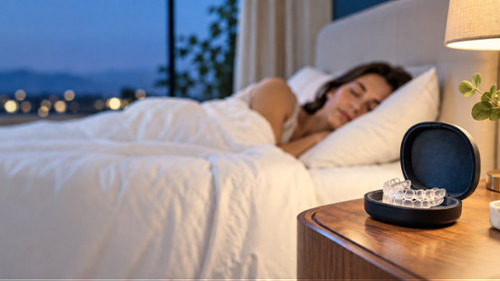
A custom oral sleep appliance is a small, removable device worn during sleep, similar in size to an athletic mouthguard or orthodontic retainer. The most common design is a mandibular advancement device, which gently holds the lower jaw in a slightly forward position. That small shift pulls the tongue and surrounding soft tissue away from the back of the throat, keeping the airway open and preventing the collapses that cause snoring and apnea events.
Unlike an over-the-counter boil-and-bite mouthguard, a properly prescribed sleep appliance is designed from a precise digital scan of your teeth and bite, then custom-milled to fit your mouth exactly. Appliances like OptiSleep, which we use at Hudzinski Dental, allow for incremental titration, meaning small adjustments over time that fine-tune the jaw position for maximum effectiveness while keeping the bite comfortable. Treatment is coordinated with your sleep physician, who confirms the diagnosis, monitors effectiveness, and manages the medical side of your care alongside the dental side.
Types of Oral Sleep Appliances
Not all oral sleep appliances are built the same way. Here is how the main categories compare.
| Appliance Type | How It Works | Best For |
|---|---|---|
| Mandibular Advancement Device | Connected upper and lower trays hold the jaw slightly forward, adjustable in small increments | Mild to moderate OSA; the most widely prescribed and researched design |
| Tongue-Retaining Device | Uses gentle suction to hold the tongue forward instead of repositioning the jaw | Patients with limited teeth to anchor a MAD, or jaw joint sensitivity |
| Combination Appliance | Blends jaw advancement with tongue stabilization for more complex airway anatomy | Cases where a standard MAD alone does not fully resolve symptoms |
| Boil-and-Bite (Over-the-Counter) | Generic, non-custom fit with no diagnostic monitoring | Not recommended for diagnosed sleep apnea; lacks precision and medical oversight |
At Hudzinski Dental, we prescribe custom mandibular advancement devices, most often the OptiSleep appliance, for their precise digital fabrication, incremental titration control, and strong track record in clinical studies for treating mild to moderate obstructive sleep apnea.
What to Expect: The Treatment Process
Getting started with oral appliance therapy takes a few visits spread over several weeks. Here is what happens at each stage.
1. Evaluation
We review your symptoms, examine your airway and bite, and discuss whether a sleep study is needed to confirm a diagnosis before any appliance is considered.
2. Sleep Study
If you do not already have a diagnosis, a home sleep study or a referral to a sleep physician confirms whether you have obstructive sleep apnea and how severe it is.
3. Digital Scan
We use our digital scanning technology to capture a precise 3D model of your teeth and bite, the same technology used for our implant and restorative patients. No impression putty, no mess.
4. Custom Fabrication
Your appliance is custom-milled to your exact bite. This typically takes a few weeks from the digital scan to delivery.
5. Fitting and Titration
Dr. Hudzinski or Dr. Fryer fits the appliance and makes small, incremental adjustments over several visits to find the jaw position that resolves symptoms comfortably.
6. Follow-Up Sleep Study
A follow-up study confirms the appliance is effectively controlling your apnea, and periodic check-ins keep the fit and effectiveness on track long term.
Good to know: Because titration happens in small increments over several visits, most patients adjust to their appliance gradually and comfortably, rather than all at once. It is normal to need a few fine-tuning visits before symptoms fully resolve.
Oral Appliance Therapy vs. CPAP
CPAP remains the gold-standard treatment for moderate to severe sleep apnea, and it is highly effective when used consistently. In practice, though, many patients struggle to stick with it. Here is how the two approaches compare.
| Oral Appliance | CPAP | |
|---|---|---|
| Comfort | Small, quiet, no mask or hose | Mask and airflow can feel intrusive to some users |
| Travel and Power | Fits in a pocket, no electricity needed | Requires power and travel-sized equipment |
| Compliance | Typically higher long-term adherence | Effective, but many patients stop using it regularly |
| Best Suited For | Mild to moderate OSA | Moderate to severe OSA |
Some patients use both therapies together: an oral appliance on nights when CPAP is not practical, such as travel, and CPAP for consistent nightly use at home. The right combination depends on your diagnosis and how your body responds, which Dr. Hudzinski and Dr. Fryer will discuss with you alongside your sleep physician. For a closer look at how the two compare, see our guide on oral appliance therapy vs. CPAP.
The Benefits of Oral Appliance Therapy
- Comfortable and quiet. No mask, no hose, and nothing to wake a partner.
- Travel-friendly. Fits in a pocket or bag, with no electricity or equipment to pack.
- Better daytime energy. Patients commonly report improved focus and less fatigue once treatment is effective.
- Long-term health protection. Treating OSA lowers the associated risk of high blood pressure, heart disease, and stroke.
- Higher adherence. Because it is easy to wear consistently, many patients stick with it more reliably than CPAP.
Tired of being tired?
Find out if a custom oral appliance can treat your sleep apnea without a mask or hose.
Schedule a Consult Today! Call (440) 585-4200Is Oral Appliance Therapy Right for You?
You may be a good candidate for a custom oral sleep appliance if you:
- Have been diagnosed with mild to moderate obstructive sleep apnea
- Have tried CPAP but find it uncomfortable, noisy, or hard to use consistently
- Snore heavily, especially if a partner has noticed pauses in breathing
- Travel frequently and want a compact, electricity-free option
- Have enough healthy teeth to support a custom-fit appliance
Severe obstructive sleep apnea can sometimes be treated with an oral appliance, but it is more often managed with CPAP or a combination of both. Your sleep physician and dentist will work together to determine the right approach based on your diagnostic results. Not sure if your symptoms point to sleep apnea at all? Our guide on the warning signs most people miss is a good place to start.
Medical Insurance Coverage
Because obstructive sleep apnea is a medical diagnosis, oral appliance therapy is typically billed to medical insurance rather than dental insurance. Coverage and requirements vary by plan, so our team will help you understand your specific benefits and what documentation your medical insurer requires before treatment begins.
Frequently Asked Questions
Is an oral sleep appliance as effective as CPAP?
For mild to moderate obstructive sleep apnea, custom oral appliances are highly effective and often comparable to CPAP in real-world outcomes, largely because patients wear them more consistently. For severe OSA, CPAP typically remains the more effective first-line option, though some patients use both together.
Do I need a sleep study before getting a dental sleep appliance?
Yes. A sleep study, whether a home test or an in-lab study, confirms whether you have obstructive sleep apnea and how severe it is. This diagnosis guides whether an oral appliance is an appropriate treatment or whether CPAP or another approach is recommended instead.
What is the OptiSleep appliance?
OptiSleep is a custom mandibular advancement device that repositions the lower jaw slightly forward during sleep to keep the airway open. It is digitally designed from a precise scan of your teeth and allows for gradual, controlled adjustments as treatment progresses.
Will an oral sleep appliance move my teeth?
Properly fitted appliances are monitored closely to minimize this risk, though minor bite changes are possible with long-term wear. Regular follow-up visits allow Dr. Hudzinski or Dr. Fryer to check your bite and adjust the appliance as needed to protect your dental health over time.
How long does it take to get an oral sleep appliance?
After your evaluation and diagnosis, fabrication of a custom appliance typically takes a few weeks. Following delivery, expect several short titration visits over the following weeks to fine-tune the fit before a follow-up sleep study confirms effectiveness.
Can a dentist in Cleveland treat my sleep apnea without a doctor?
No. Sleep apnea is a medical diagnosis, and treatment always involves your sleep physician alongside your dentist. Dr. Hudzinski and Dr. Fryer coordinate directly with your physician to confirm diagnosis, monitor treatment effectiveness, and ensure your care meets accepted medical standards.
A Natural Next Step
Better sleep starts with a conversation.
Dr. Kevin Fryer founded our practice in 1992, and Dr. Matthew Hudzinski now leads it, with both doctors providing custom oral appliance therapy for patients across Cleveland's east side. If snoring or fatigue has you concerned, we would be glad to talk it through.
Schedule a Consult Today! Sleep Apnea and Snoring TreatmentRelated Reading
- Oral Appliance Therapy vs. CPAP: Which Sleep Apnea Treatment Is Right for You?
- Do You Have Sleep Apnea? The Warning Signs Most People Miss
- Same-Day CEREC Crowns Explained
This article is for general education and is not a substitute for a medical or dental evaluation. Sleep apnea is a medical condition that requires diagnosis by a qualified physician, and individual results from oral appliance therapy vary. Hudzinski Dental, 1232 SOM Center Road, Mayfield Heights, OH 44124 | (440) 585-4200